 ultimate-guide
How to Find Reputable Masonry Companies: A Complete Guide
Quick Summary
To find reputable masonry companies, research local reviews and referrals, verify the license, insurance and bonding with the issuing agencies, check references, and compare bids line by line rather than by total price. Confirm the contract terms, payment schedule and warranty before signing.
- Verify license numbers directly with the issuing agency, not through documents the contractor sends.
- Request a certificate of insurance from the agent and confirm the policy is active on your project dates.
- Call at least two past customers and ask about schedule, budget, and how problems were handled.
- Normalize every bid to the same line items and write 'not included' wherever a bid is silent.
- Tie payments to completed milestones and get lien waivers when the project is paid in full.
Table of Contents
- How to Find Reputable Masonry Companies: A Complete Guide
- Why Choosing the Right Masonry Company Matters
- Start With Local Research and Online Reviews
- Verify Licenses, Insurance, and Bonding
- Check Experience, Past Projects, and Masonry Contractor References
- Questions to Ask a Masonry Contractor Before You Hire
- How to Compare a Masonry Estimate Apples-to-Apples
- Red Flags and Contract Safeguards to Confirm Before Signing
- Scheduling Your Consultation With Solid Rock Brick
- Frequently Asked Questions
How to Find Reputable Masonry Companies: A Complete Guide
Last Updated: November 7, 2026
Why Choosing the Right Masonry Company Matters
Solid Rock Brick has spent 16 years building stone, brick and concrete work in Jackson, Mississippi. Homeowners and property managers who hire the wrong masonry companies can end up paying twice. A failed retaining wall, a driveway that cracks within a season, or a dumpster enclosure built without proper footings all trace back to the hiring decision. Choosing a reputable masonry company is the single most important step in protecting your property.
Masonry is a structural trade: walls hold back soil, steps carry foot traffic, and foundations and pool decks take real loads. A poor job rarely looks poor on day one; failure shows up after the first freeze-thaw cycle or heavy rain, which is why many owners only learn the difference years later.
The good news is that you can screen for reliability before work begins. The steps below cover local research, license and insurance checks, reference calls, apples-to-apples bid comparison and the contract terms worth confirming before you sign.
Start With Local Research and Online Reviews
Start by building a short list of companies that actually serve your area. Search for masonry contractors in Jackson and nearby communities, then check whether each lists a physical address, a phone number and a defined service area. A business that cannot tell you where it works or who answers the phone is a weak starting point.
Ask people you trust next. Neighbors, property managers and local building suppliers know which crews finish on schedule and which leave work unfinished. Referrals carry more weight than advertising because the person recommending a mason has seen the results.
Then review the online profiles. Look at the star rating, the number of reviews, and how recent they are. Pay attention to how the company responds to criticism. Calm, specific replies that explain what was fixed are a better sign than a flawless average built on a handful of reviews.
Reading Reviews Critically
Not every review tells you something useful. Praise like "great company" says little about masonry skill. Look for reviews that describe the project type, the timeline, how change orders were handled and whether the finished work held up over time.
Watch for patterns rather than single complaints. One unhappy customer can be an outlier; five reviews mentioning missed start dates or a crew that vanished mid-job point to a systemic problem. Be wary of reviews that all arrived in the same week or describe no specific work.
Verify Licenses, Insurance, and Bonding
Before you compare prices, confirm that the company is legally able to do the work and financially able to stand behind it. This is the step most homeowners skip, and it decides whether you have recourse when something goes wrong.
Licensing and registration. Contractor licensing is set at the state and local level, and masonry work is often regulated differently from general contracting. Start with your city or county building department and ask two questions: does this scope of work require a licensed contractor, and which permits and inspections apply?
General liability insurance. Ask for a certificate of insurance (COI) sent directly from the contractor's insurance agent or broker, not forwarded by the contractor.
Workers' compensation. If the crew has employees, workers' compensation is what keeps an on-site injury from becoming your liability. Ask for the workers' comp certificate and confirm the policy is active. If the contractor says the crew is all subcontractors, ask for each subcontractor's certificate as well, because an uninsured sub injured on your property can still create a claim against you.
Bonding. A surety bond is a financial guarantee, usually issued by an insurance company, that the contractor will perform the work and meet obligations such as paying suppliers and subcontractors.
Liens and payment protection. Even a well-insured contractor can leave unpaid suppliers or subcontractors behind, and those parties may file a mechanic's lien against your property. Ask the contractor how they handle lien waivers and whether they will provide conditional waivers as payments are made and a final unconditional waiver when the job is paid in full.
Keep a simple file for every company you are considering: license number and verification date, COI with policy dates and limits, workers' comp certificate, bond information if applicable, and the name and phone number of the person who confirmed each item. If a contractor resists providing any of these, that resistance is itself information. A reputable masonry company expects to be asked and can produce the documents without delay.
Check Experience, Past Projects, and Masonry Contractor References
Years in business matter, but they are not the whole picture. A company with 16 years of work in your area has likely faced local conditions, such as soil, moisture, seasonal freeze-thaw, and building requirements, but the length of time in business should be matched against the specific work you need. Ask how long the company has performed the specific work you need, not just how long it has existed.
Ask to see a portfolio of completed projects that resemble yours. For a driveway repair, look at driveways. For a commercial dumpster enclosure, look at enclosures. Photos are useful, but ask to see the work in person when possible. Surface finish looks good in a photo; joint alignment, drainage and the way edges meet the ground show up only on site.
Call at least two references and prepare specific questions. Ask whether the project finished on schedule, whether the budget held, how the company handled problems, and whether the work still looks sound. Past customers are often the most honest source you will find.
Questions to Ask a Masonry Contractor Before You Hire
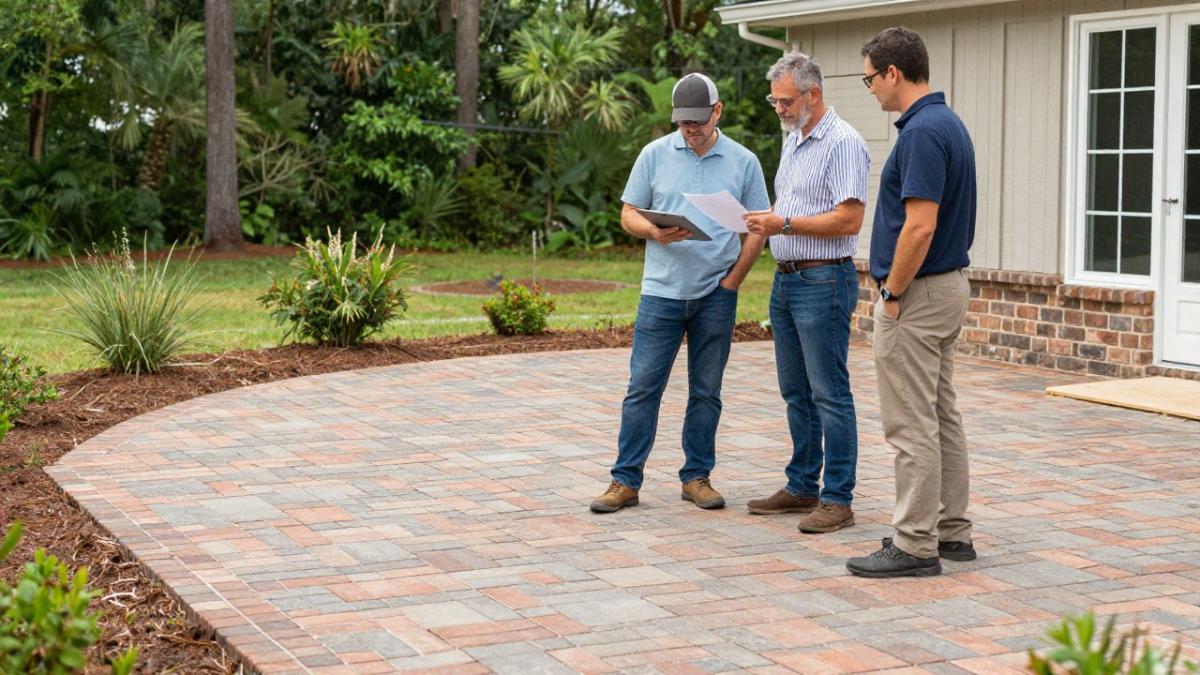
The right questions reveal how a company operates before you hire it. Ask who will be on site each day and whether they are employees or subcontractors. Ask who you call if a problem appears after the project ends, and how quickly they respond.
Ask how the company handles permits and inspections, and who is responsible for pulling them. Ask how change orders are priced and approved in writing, so unexpected costs do not appear on the final invoice.
Ask about warranty coverage in specific terms: what is covered, for how long, and what voids it. A general promise of quality is not a warranty. For a deeper look at how these terms should appear in writing, see the contract section below.
How to Compare a Masonry Estimate Apples-to-Apples
Masonry bids are hard to compare because companies quote different scopes, and the totals hide the differences. Stop comparing totals first and normalize every bid to the same line-item structure.
Scope and quantities. List the work in measurable terms: square footage of wall or patio, linear feet of retaining wall, number of steps, chimney height, and the area of any demolition. Ask each contractor to state quantities, not just a lump sum.
Site preparation and demolition. Confirm who removes the old surface, who hauls away debris, and whether dumpster and disposal fees are included. For a patio or driveway, ask whether excavation, grading, and compacted base are in the bid.
Materials and specifications. Require the bid to name the material type, size, color, and manufacturer or source where relevant, plus the mortar type and reinforcement.
Drainage and water management. Ask how each bid handles water: slope away from the structure, weep holes in veneer walls, flashing at roofs and chimneys, and drainage behind retaining walls.
Labor, access, and schedule. Confirm who provides scaffolding, lifts, and protection for landscaping and siding, and whether the bid assumes clear access to the work area. State the start date, the expected duration, and who is responsible for weather delays.
Permits, inspections, and cleanup. Confirm whether the contractor pulls permits, who pays permit fees, and who schedules inspections. Confirm that final cleanup, sweeping, and removal of mortar residue are included.
Exclusions and allowances. Every bid should list what it does not include: structural repair found after demolition, painting or sealing, landscaping restoration, or work on adjacent surfaces.
Payment schedule and validity. Compare deposits, progress payments, and final payment terms side by side, and note how long each bid remains valid. A bid that requires a large deposit before work begins deserves more scrutiny than one tied to measurable milestones.
Warranty and closeout. Note the workmanship warranty length, what it covers, and what voids it, plus whether the contractor provides lien waivers at closeout.
When the sheet is complete, compare three things together: total price, scope, and schedule. The lowest total is rarely the lowest risk. If one bid is far below the others, scan the rows marked "not included", that is often where the difference lives. Ask each contractor to revise the bid to address any missing row before you decide, and keep the revised written bids in your file alongside the license, insurance, and bond documents.
Red Flags and Contract Safeguards to Confirm Before Signing
Several warning signs should stop you from signing. Be cautious of a contractor who demands full payment upfront, pressures you to decide immediately, refuses to put the estimate in writing, asks for cash only or cannot provide proof of insurance. Be equally cautious of anyone who wants to skip the permit process.
Before you sign, confirm that the written contract includes the project scope and materials, the start and completion dates, the payment schedule tied to completed work, the change-order process, the warranty terms, the insurance and license information, and how disputes are resolved.
Keep payments tied to progress and avoid paying for work that has not been completed. Hold back a final payment until the work is finished and inspected, and get lien waivers when the project is paid in full, so subcontractors cannot place claims on your property.
Scheduling Your Consultation With Solid Rock Brick
If you are ready to compare a qualified local option, Solid Rock Brick offers residential and commercial masonry work in Jackson, MS, including stone work, brick work, and concrete installations. Our team can walk through your site, explain the scope, and provide a written estimate you can compare line by line against other bids.
Reach out to request a consultation, and bring the questions from this guide.
Frequently Asked Questions
What does a mason charge per hour?
Hourly rates for masons vary with region, crew size, job complexity and whether the work is residential or commercial. Rather than relying on a generic figure, ask each company for a written estimate that breaks out labor, materials, equipment and cleanup. Pricing depends on quantity, dates and delivery, so request a current quote from Solid Rock Brick for an accurate number tied to your specific project.
What is the best way to find a good masonry contractor?
Combine several sources: referrals from neighbors and property managers, reviews on Google and other platforms, and direct verification of licenses and insurance. Shortlist three to four companies that have completed projects similar to yours, then compare their written estimates, references and project portfolios before deciding.
What should a masonry estimate include?
A complete masonry estimate should list the scope of work, materials with grades or specifications, labor, site preparation, demolition or removal of old material, permit responsibilities, cleanup, payment schedule, warranty terms and an estimated start and finish date. If one bid omits items another includes, the lower price may not be a true lower cost.
Should a masonry contractor provide a written contract?
Yes. A written contract protects both parties and should describe the scope, materials, timeline, payment schedule, change-order process, warranty and who handles permits and inspections. Avoid companies that want a large upfront deposit or resist putting terms in writing.