 blog
Foremost Foundations Alternatives: 2026 Guide
Table of Contents
- Why Homeowners Look Beyond Foremost Foundation
- Understanding Foundation Repair Estimate Components
- Foundation Repair Cost Factors and Pricing Transparency
- Repair Methods: Helical Piers, Wall Anchors, and Concrete Lifting
- Foundation Repair Warranties and Long-Term Protection
- How to Verify Contractor Qualifications and Experience
- Making Your Final Decision
- Frequently Asked Questions
Last Updated: October 12, 2026
Why Homeowners Look Beyond Foremost Foundation
When you're facing foundation damage, the instinct is to call the first contractor you find. But the wrong choice can leave you with incomplete repairs, warranty gaps, or structural issues that resurface years later.
This guide walks you through evaluating foundations alternatives and identifying contractors who deliver lasting results.
Foundation repair isn't one-size-fits-all. A slab settling unevenly demands a different solution than a crawl space with water intrusion, and a contractor who excels at one method may lack expertise in another.
Understanding Foundation Repair Estimate Components
Most foundation repair quotes are one-page documents with a lump-sum number and a vague description like "stabilize foundation," making fair comparison nearly impossible. Here's what a defensible estimate contains.
**1.
2. Repair method and why it was chosen. The estimate should state the method, why it fits your foundation type and soil, and what alternatives were rejected.
3. Quantity of repair points. Piers, anchors, and injection points are priced per unit.
4. Labor versus materials, itemized. Steel piers, brackets, epoxy, grout, and foam are materials; excavation, installation, welding, and restoration are labor.
**5.
6. Timeline and milestones. Total days on site, whether the home is habitable during work, and whether the crew works consecutive days or splits the job.
7. Cleanup, restoration, and exclusions. What's replaced, sod, concrete, landscaping, interior drywall cracks? What's explicitly excluded? Exclusions are where disputes start.
How to compare two estimates fairly. Match line item to line item. If Contractor A lists 8 piers at 20 feet embedment and Contractor B lists 6 at 12 feet, they aren't bidding the same job, B proposes a shallower repair that may not reach stable soil. The lower number isn't a better deal; it's a different scope.
Red flags in an estimate. A total price with no unit counts. A method described only by brand name. No stated cause of movement. No warranty reference. No exclusions list.
What estimates legitimately vary on. Two honest contractors can disagree on method, pier count, or whether drainage work is needed, foundation repair involves engineering judgment. What shouldn't vary is the transparency of the document.
Inspection and quote fees. Some contractors charge for the initial inspection, especially with a licensed engineer involved; many offer free estimates as a sales tool.
Getting a second opinion from an engineer. For anything beyond minor cosmetic cracking, a stamped report from a licensed professional engineer is worth the cost.
Foundation Repair Cost Factors and Pricing Transparency
Pricing is the topic every competitor page avoids, because real numbers invite comparison.
The seven cost drivers, in order of impact.
1. Number of repair points. Piers, anchors, and injection points are priced per unit; a typical residential job may involve a handful to a couple dozen points.
2. Embedment depth. Deeper piers reach more stable bearing soil and cost more per point.
3. Foundation type and access. Slab, crawl space, and basement foundations each require different equipment and labor. Tight lots, finished basements, and protected landscaping all add cost.
4. Extent and pattern of damage. Localized settling in one corner is a smaller job than movement affecting multiple walls or the entire perimeter, which often requires a phased or full-perimeter approach.
5. Soil and water conditions. Expansive clay soils, high water tables, and poor drainage drive both the repair method and accompanying drainage work.
6. Method selected. Underpinning with piers, wall anchors, carbon-fiber straps, concrete lifting, and full replacement carry very different price structures.
7. Region and market conditions. Labor rates, material costs, and contractor availability vary by metro area and season. A quote that looks high in one market may be normal in another.
How to read a written estimate for pricing transparency. A defensible estimate shows unit counts and unit pricing, or a clear scope that lets you back into them. If two contractors quote the same total but one lists twice the piers, the per-pier price differs by roughly half, ask why. That surfaces whether the cheaper bid is under-scoped or the pricier bid is padded.
Questions that force pricing transparency.
- What is the per-unit cost for each pier or anchor?
- What embedment depth is included, and what happens if stable soil is deeper than expected?
- Is drainage work included, or quoted separately?
- Are permits, engineering letters, and site restoration in the total?
- What is the payment schedule, and how much is due before work begins?
- Is there a change-order process if conditions differ from the estimate?
Payment structure as a red flag. Reputable contractors typically ask a modest deposit, progress payments tied to milestones, and a final payment after walkthrough.
Insurance and financing. Some homeowner policies cover foundation damage tied to specific perils like plumbing leaks while excluding long-term soil movement, review your policy and ask your adjuster directly.
Repair Methods: Helical Piers, Wall Anchors, and Concrete Lifting
Different foundation problems require different repair strategies, and the method chosen directly impacts long-term success. Understanding these approaches helps you judge whether a contractor's recommendation fits your situation.
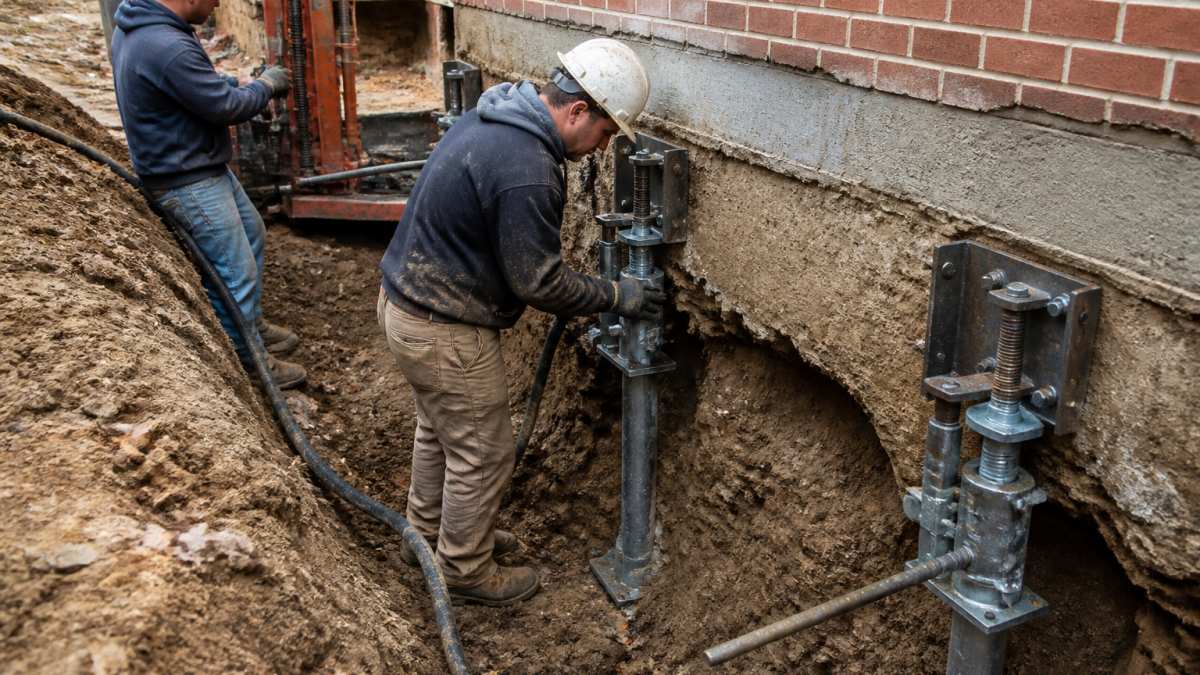
Helical piers screw large steel shafts deep into stable soil beneath the foundation, transferring the building's weight to deeper, more stable ground layers. They're effective for foundations that settled due to poor soil or inadequate original support, and useful for underpinning without extensive excavation. The downside: significant soil disturbance, and they work best in certain soil types.
Wall anchors stabilize foundation walls bowing or cracking inward from soil pressure or water damage. Steel cables or rods anchored to the wall on one end and a ground anchor on the other create tension that prevents further movement.
Concrete lifting, also called mudjacking or foam jacking, raises sunken slabs by injecting material beneath them. It works for unevenly settled slab foundations, driveways, and patios. It's quick and non-invasive, but doesn't address the cause of settlement, so it's typically temporary unless combined with structural repairs.
Each method has appropriate applications. A contractor recommending the same solution for every problem isn't assessing your situation carefully. The best evaluate your foundation type, damage, soil conditions, and long-term goals before recommending an approach.
Foundation Repair Warranties and Long-Term Protection
A warranty is your protection against future problems, yet many homeowners overlook warranty details when choosing a contractor, a mistake that can cost thousands if repairs fail.
Strong warranties typically cover the repair work for 10 to 25 years depending on method and contractor, but terms vary significantly. Some cover only materials, not labor. Others exclude damage from factors outside the contractor's control, like extreme weather or additional settling.
Ask specifically what the warranty covers: Is the repair method covered permanently or for a limited time? If a pier settles or an anchor fails, does the contractor return at no cost? Is new damage in an adjacent area covered?
Transferability matters if you plan to sell. A warranty that transfers to the next owner adds value and buyer confidence, and some contractors offer it while others don't, a difference that can affect resale value.
Document everything: the estimate, contract, warranty paperwork, and before-and-after photos. If problems arise years later, this proves what work was done and what warranty protection applies.
Be wary of unusually long warranties without clear limitations. A 50-year warranty on foundation repair is marketing language, not a realistic commitment, foundation movement can occur for reasons beyond the contractor's control. A reasonable warranty reflects confidence while acknowledging that foundations are complex systems.
How to Verify Contractor Qualifications and Experience
Before hiring any contractor, verify their qualifications and track record. This separates experienced professionals from operators who might damage your foundation further.
Start with licensing. Most states require contractors to be licensed, and status is public. Verify the license is current and in good standing, and check for complaints or disciplinary actions through your state's licensing board.
Insurance is equally important. Ask for proof of general liability and workers' compensation coverage, a contractor without it puts you at risk if someone is injured on your property or adjacent structures are damaged.
Look for industry certifications. Organizations like the National Association of Certified Home Inspectors (NACHI) and the American Society of Home Inspectors (ASHI) maintain standards for foundation assessment and repair; certified contractors have demonstrated knowledge and committed to ongoing education.
Ask for references and follow up. A contractor should readily provide recent customers who can speak to their work quality and reliability. Call them and ask: Did the work finish on schedule? Did the repair solve the problem?
Visit past projects if possible. Seeing completed work builds confidence in the contractor's craftsmanship and attention to detail; ask whether you can photograph their work for comparison.
Check online reviews on multiple platforms, but with skepticism. One negative review among dozens of positives may reflect an unrealistic expectation; all five-star reviews with generic language might be fabricated.
Ask about their experience with your specific foundation type and repair method. A contractor experienced with helical piers may have limited wall anchor experience. Choose someone who regularly handles your particular situation.
Making Your Final Decision
Choosing a foundation repair contractor means balancing cost, methodology, qualifications, warranty terms, and your gut feeling about whether you trust them.
Create a comparison table for the contractors you're seriously considering: recommended repair method, estimated cost, warranty terms, timeline, and key qualifications. This visual comparison often makes the best choice clearer.
Trust your instincts about communication and professionalism. A contractor who listens carefully, answers thoroughly, and explains their reasoning builds confidence; someone who rushes the consultation or uses high-pressure sales tactics is a red flag.
Don't decide on price alone. The cheapest option often reflects corners cut that will haunt you for years, and the most expensive isn't automatically best. Look for the best combination of reasonable pricing, transparent methodology, strong qualifications, and a warranty you trust.
Ask whether you'd confidently refer this contractor to a friend or family member. If not, keep looking.
When foundation damage threatens your home's structural integrity, the stakes are too high for a poor decision. At Solid Rock Brick, we understand that foundation repair extends beyond structural stabilization, it's about protecting your investment and your peace of mind. Our 16 years of experience working with residential and commercial properties in the Jackson area has taught us that the right contractor combines technical expertise with transparent communication and genuine commitment to lasting results. Your foundation, and your home's future, depends on it. Contact Us to discuss your foundation concerns and explore repair solutions backed by expertise and accountability.
Frequently Asked Questions
What should a foundation repair estimate include?
A complete foundation repair estimate should detail the inspection findings, specific repair methods recommended, labor and material costs broken down by line item, project timeline, warranty coverage, and payment terms. Reputable contractors provide written estimates that explain why certain repairs are necessary and what structural issues they address. Ask for references to past projects of similar scope to verify the contractor's accuracy in estimating.
Are helical piers a permanent fix for foundation problems?
Helical piers are a long-term structural solution designed to stabilize sinking or settling foundations by anchoring deep into stable soil. When installed correctly by a qualified contractor, they can halt foundation movement and provide permanent support. However, their effectiveness depends on proper installation, soil conditions, and ongoing water management around the foundation. Regular inspections help ensure they continue performing as intended over decades.
How do I compare foundation repair contractors?
Compare contractors on experience, licensing, insurance coverage, inspection methods, warranty terms, and customer references. Request written estimates from at least two providers and review what each includes. Check reviews from past residential and commercial clients. Ask about their approach to water management and drainage, which prevents future foundation damage. Verify they're licensed and insured in your state, and ask how long they've served the local area.
What makes foundation repair warranties valuable?
A strong warranty demonstrates the contractor's confidence in their work and protects your investment if problems arise. Look for warranties that cover the repair method itself (materials and workmanship) and any structural issues that recur within the coverage period. Longer warranties, typically 10-25 years, indicate the contractor stands behind their installation. Verify warranty terms in writing and understand what's excluded, such as damage from poor drainage or new settling in untreated areas.