 blog
7 Commercial Masonry Maintenance Services for Jackson Properties
Last Updated: October 26, 2026
Quick Summary
Commercial masonry maintenance is essential for protecting your building's structural integrity and appearance. Regular maintenance prevents costly emergency repairs and extends the lifespan of brick, stone, and concrete structures that define your facility's curb appeal.
- The masonry industry generates $34.8 billion annually across the United States, reflecting its significant role in property management.
- A comprehensive maintenance plan includes quarterly or semi-annual inspections, mortar joint assessment, cleaning, and minor repointing.
- Jackson's seasonal temperature swings, high humidity, and heavy rainfall accelerate mortar deterioration and moisture infiltration.
- Buildings aged 0-15 years need annual inspections; 15-30 years need semi-annual; 30+ years need quarterly attention.
- Horizontal or stair-step cracking, bowing walls, and water entry warrant escalation to a structural engineer for professional assessment.
Table of Contents
- Why Commercial Masonry Maintenance Matters for Jackson Properties
- What's Included in a Commercial Masonry Maintenance Plan
- Creating a Masonry Inspection Checklist for Your Facility
- Brick Mortar Repair and Commercial Tuckpointing Explained
- Commercial Masonry Maintenance Scope and Service Frequency
- Jackson Climate and Building Considerations for Masonry Durability
- How to Evaluate and Select a Commercial Masonry Contractor
- 1. Verify commercial experience, not just masonry experience
- 2. Confirm licensing, insurance, and safety posture
- 3. Compare proposals on scope, materials, and assumptions
- 4. Scrutinize warranty and workmanship terms
- 5. Evaluate communication and scheduling discipline
- 6. Check references against your specific risk profile
- A practical bid comparison scorecard
- Schedule Your Commercial Masonry Assessment with Solid Rock Brick
- Frequently Asked Questions
Why Commercial Masonry Maintenance Matters for Jackson Properties
Commercial masonry maintenance is essential for protecting your building's structural integrity and appearance. The masonry industry generates $34.8 billion annually across the United States, reflecting the significant role these services play in property management and commercial real estate operations, according to IBISWorld's Masonry Industry Analysis.
Weather exposure, moisture infiltration, and temperature fluctuations cause mortar to crack, bricks to spall, and structural problems to develop. Properties with proactive maintenance plans can avoid the cost premiums of emergency restoration work.
Timing separates well-maintained masonry from deteriorated facades: small repairs cost hundreds, while major structural failures cost tens of thousands.
What's Included in a Commercial Masonry Maintenance Plan
A comprehensive commercial masonry maintenance plan combines inspection, preventive treatment, and targeted repairs, typically including quarterly or semi-annual inspections, mortar joint assessment, cleaning, and minor repointing. Browse all available services to find maintenance options suited to your property. Solid Rock Brick offers masonry services covering each area.
The core components break down as follows:
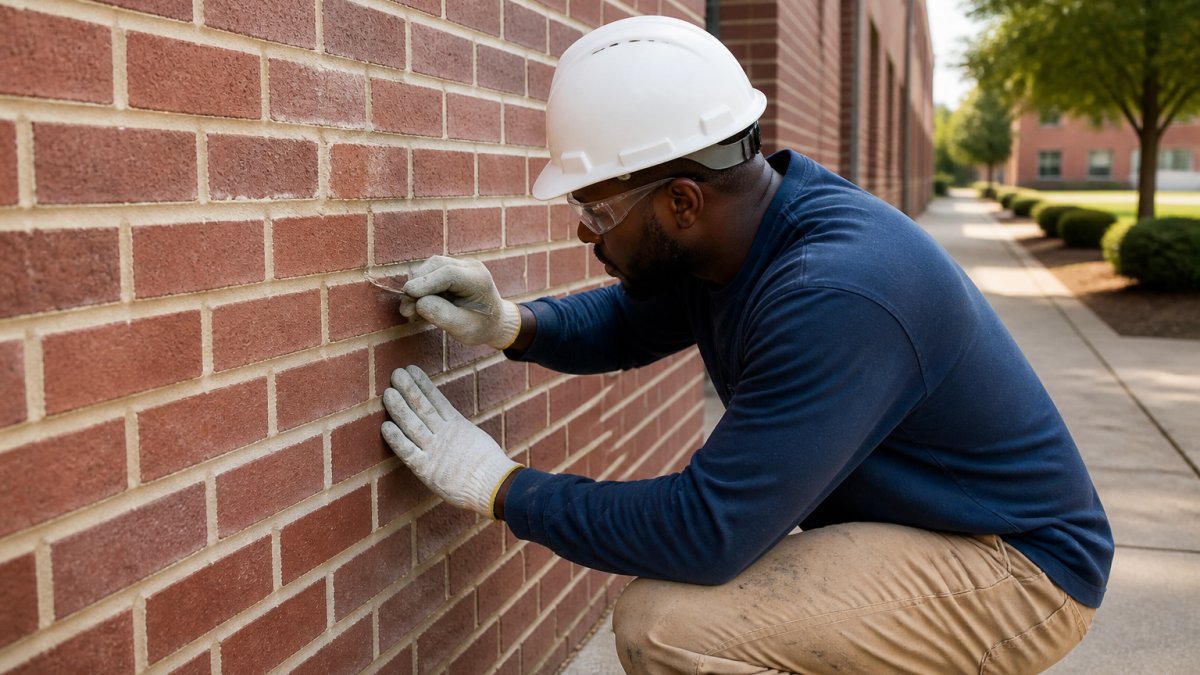
- Structural inspection: Visual assessment of brick, stone, and concrete surfaces for cracks, spalling, and movement
- Mortar joint evaluation: Checking for deterioration, gaps, and water infiltration points
- Cleaning and debris removal: Removing dirt, algae, and environmental buildup that accelerates deterioration
Solid Rock Brick offers masonry services covering each area. Match scope to your property's age, material type, climate exposure, and condition.
Creating a Masonry Inspection Checklist for Your Facility
A commercial masonry inspection checklist is not a walkaround. On an occupied property, it must produce defensible records, prioritize work by risk, and fit tenant schedules and access constraints, so property managers can hand a contractor a scope, justify a budget line, and track deterioration across cycles.
Inspection cadence by building profile
Set frequency by the building's age, material system, and exposure before you walk the facade:
- 0-15 years, moderate exposure: annual visual inspection plus a post-storm check after any hail or wind event.
- 15-30 years or high exposure (freeze-thaw, prevailing wind-driven rain, flat-roof drainage at walls): semi-annual inspection, with a close-up review of parapets and roof-line transitions each spring.
- 30+ years, historic masonry, or known prior repairs: quarterly visual inspection and an annual close-up inspection from swing stage or lift at representative elevations.
Inspect the same elevations in the same order each cycle so photo pairs are comparable year over year. Assign separate checklists to each wing or addition.
What to record at each inspection point
- Mortar joints: note joint width, depth of recession, and whether mortar crumbles under a finger or probe. Flag joints receded more than roughly 1/4 inch and any joint where the mortar is softer than the brick or stone it bonds.
- Brick and stone surfaces: record spalling, delamination, and any unit that has moved out of plane. Photograph each affected area with a scale reference and a fixed vantage point.
- Cracks: measure width and length, note orientation (vertical, horizontal, stair-step), and mark whether the crack is active by installing a simple crack monitor or marking the ends with a date. Hairline cracks under 1/16 inch are typically monitored; cracks at or above 1/4 inch, horizontal cracks, and stair-step patterns warrant engineering review.
Documentation that survives a budget review
For each finding, capture location (elevation, grid line, or photo reference), description, severity (monitor / repair this cycle / engineer review), and recommended action with a rough order of magnitude. Keep a running photo log by elevation to show ownership a time-lapse of deterioration rather than one inspection's opinion.
Access and occupied-building logistics
Commercial inspections often require ladders, lifts, or swing stage while tenants are working. Build these into the scope:
- Confirm roof access and tenant notification requirements before the inspection date.
- Identify elevations requiring a lift or swing stage versus binoculars or a drone (where permitted).
- Note areas where debris could fall onto walkways, parking, or entrances, and require the contractor to describe fall protection and debris containment.
When to escalate from monitoring to engineering review
Include a clear escalation rule so findings do not sit unresolved between cycles. Escalate to a structural engineer or a contractor with structural repair experience for horizontal or stair-step cracking, bowing or bulging walls, multiple adjacent units displaced, mortar failure across a large contiguous area, or water entry into interior spaces, patterns repointing alone will not fix.
A well-built checklist turns a subjective walkaround into a repeatable program: catch changing cracks, document them consistently, and hand a contractor a scope specific enough to price and prioritize.
Brick Mortar Repair and Commercial Tuckpointing Explained
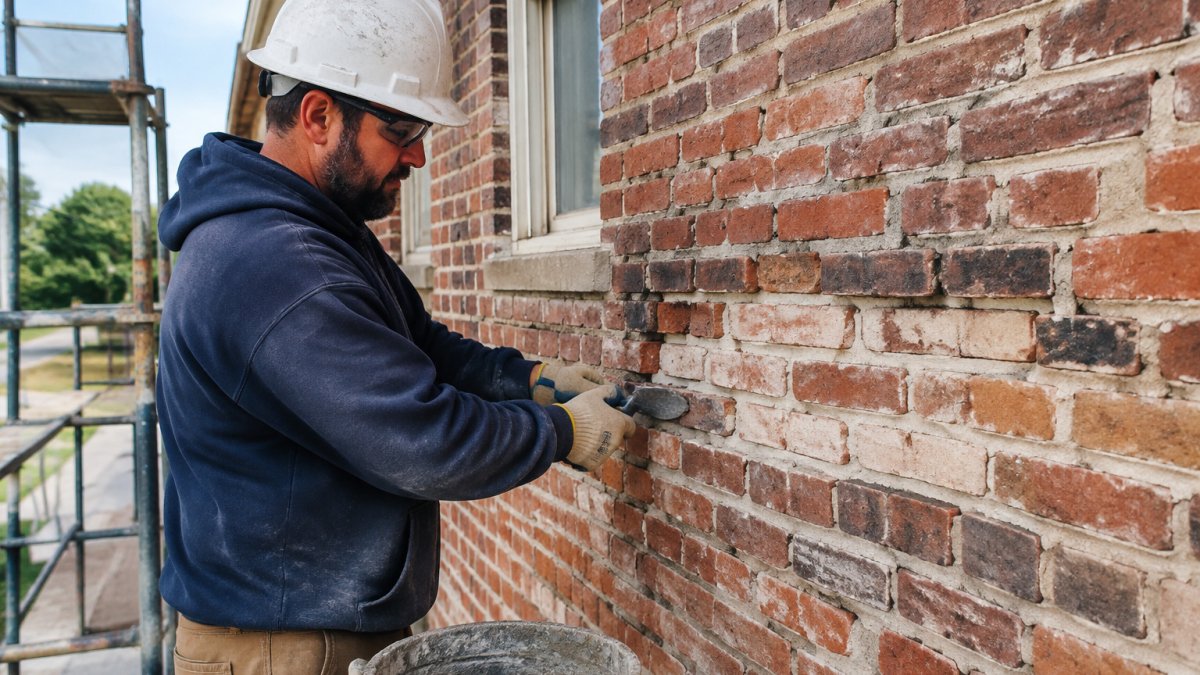
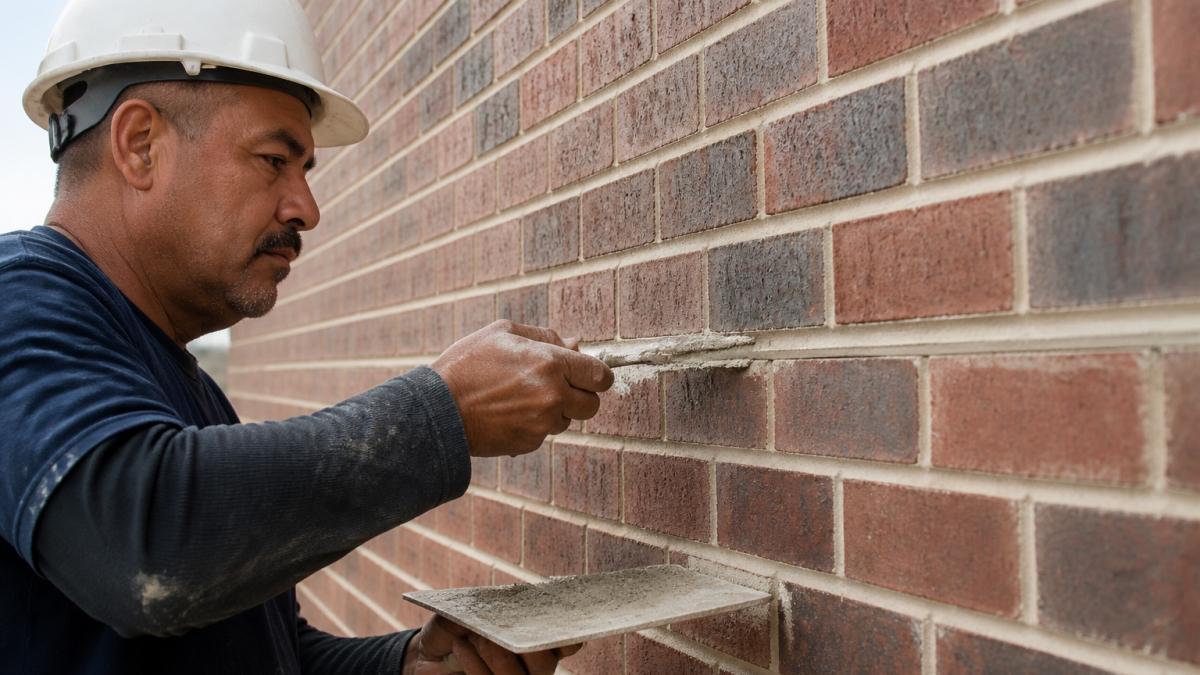
Brick mortar repair is the process of removing deteriorated mortar between bricks and replacing it with fresh mortar matching the original in color, strength, and composition.
When Mortar Deterioration Signals Structural Risk
Not all mortar problems are cosmetic. Watch for these warning signs of deeper structural issues:
- Horizontal or stair-step cracking: Suggests movement or settlement, not just surface wear
- Mortar failure in multiple areas: Indicates the problem is systemic, not localized
- Bowing or bulging walls: Mortar failure combined with outward wall movement is a serious structural concern
When you observe these patterns, professional assessment is critical. A structural engineer or experienced masonry contractor can determine whether the problem is surface-level or a sign of deeper foundation or structural issues.
Tuckpointing vs. Full Mortar Repointing
These terms describe different scopes of work. Tuckpointing focuses on the visual joint line and includes a contrasting sealant for aesthetic effect. Full mortar repointing removes old mortar completely, cleans the joint, and replaces it with new mortar matching the original specification. Full repointing suits severe or widespread deterioration; tuckpointing works best for maintenance-level repairs where structural integrity is sound but joint appearance needs refreshing.
Commercial Masonry Maintenance Scope and Service Frequency
Commercial masonry maintenance scope varies by building age, material type, climate exposure, and occupancy. A 10-year-old office building in a moderate climate needs different maintenance than a 50-year-old historic structure in a freeze-thaw area.
Maintenance frequency typically follows this pattern:
| Building Age | Climate Exposure | Inspection Frequency | Maintenance Scope |
|---|---|---|---|
| 0-15 years | Moderate | Annually | Minor cleaning, sealant refresh |
| 15-30 years | High | Semi-annually | Inspection, selective repointing, sealant |
| 30+ years | High | Quarterly | Detailed inspection, repointing, structural assessment |
New masonry (0-15 years) generally requires annual inspections and minimal intervention. Mid-age buildings (15-30 years) benefit from semi-annual check-ups and targeted repairs. Older structures (30+ years) need quarterly attention and more aggressive maintenance.
Jackson Climate and Building Considerations for Masonry Durability
Jackson's seasonal temperature swings, high humidity, and heavy rainfall accelerate mortar deterioration and moisture infiltration.
Historic Jackson masonry often uses softer, lime-based mortar that is more vulnerable to modern weather and pollution than today's cement-based products.
Poor drainage around the foundation accelerates base-course deterioration, so gutters, downspouts, and grading must direct water away from masonry.
How to Evaluate and Select a Commercial Masonry Contractor
Directory listings tell you a contractor exists, not whether they can work on an occupied commercial building, carry the insurance your ownership requires, or stand behind repointing two winters later. This framework helps property managers compare bidders on substance rather than star ratings.
1. Verify commercial experience, not just masonry experience
Ask for projects comparable in building type, material system, and access conditions, not just square footage. A contractor who mostly repoints residential chimneys may be excellent at that work yet a poor fit for a multi-story commercial facade requiring swing stage, tenant coordination, and phased scheduling. Request two or three commercial references with similar masonry and call them directly.
2. Confirm licensing, insurance, and safety posture
- Licensing: confirm the contractor holds the licenses required for the work and jurisdiction, and that the license is active.
- Insurance: request a certificate of insurance showing general liability and workers' compensation, and confirm the limits meet your ownership or lender requirements. Ask to be named as an additional insured where your contract requires it.
- Safety: ask how the contractor handles fall protection, scaffolding and lift operations, and debris containment over walkways and entrances. For occupied buildings, request a site-specific safety plan, not a generic handbook.
3. Compare proposals on scope, materials, and assumptions
A professional commercial proposal should specify elevations and quantities, mortar mix and color match approach, joint preparation depth, access method (lift, swing stage, scaffold), phasing and tenant notification plan, debris removal, and warranty terms. Vague "repair masonry as needed" proposals can't be compared across bidders and usually lead to change orders. Ask each bidder to price the same scope; if they propose a different one, ask them to price yours as an alternate.
4. Scrutinize warranty and workmanship terms
Ask what the warranty covers, how long it runs, and what voids it. Workmanship warranties on repointing and sealant work commonly run one to five years; get the term in writing and confirm whether it covers water infiltration at the repaired joints.
5. Evaluate communication and scheduling discipline
Responsiveness before the award predicts responsiveness during the project. Ask how the contractor handles tenant notifications, daily cleanup, and change-order communication, and confirm who supervises the crew on site and how they coordinate with property management.
6. Check references against your specific risk profile
Ask references what matters on commercial work: Did the crew protect entrances and walkways? Was the site clean daily? Did the contractor flag unforeseen conditions before proceeding? Did they honor the warranty when called back? These answers separate a commercial operator from a residential crew doing commercial work.
A practical bid comparison scorecard
Score each bidder on the same criteria so the decision is defensible to ownership:
- Commercial references in similar masonry and access conditions
- Insurance limits and additional-insured status
- Site-specific safety plan and fall-protection approach
Solid Rock Brick brings 16 years of commercial masonry experience to properties in the area. Our team works on brick, stone, and concrete across commercial facilities, provides written scopes and documentation, and coordinates with property management on occupied-building logistics. If you are comparing bids, ask us for commercial references and a scope written to your inspection findings.
Schedule Your Commercial Masonry Assessment with Solid Rock Brick
Commercial masonry maintenance protects your building's structure, appearance, and property value. Delaying repairs turns small problems into expensive emergencies, act while deterioration is visible but still manageable.
Contact Solid Rock Brick today to schedule a comprehensive masonry assessment. Our team will inspect your commercial property, identify maintenance needs, and recommend a preventive plan tailored to your building's condition and budget.
A well-maintained commercial masonry system is a competitive advantage, signaling a professionally managed, structurally sound facility.
Frequently Asked Questions
What does commercial masonry maintenance include?
Commercial masonry maintenance includes regular inspections for cracks and mortar deterioration, brick and stone cleaning, mortar repointing and tuckpointing, moisture control measures, and structural reinforcement when needed. Preventive maintenance protects against water infiltration, which is the leading cause of structural damage in commercial buildings. The scope depends on your facility's age, materials, and exposure to weather.
How often should commercial brick buildings be inspected?
Most commercial masonry structures benefit from annual inspections, though older buildings or those in harsh weather conditions may need semi-annual reviews. After significant weather events (heavy rain, freeze-thaw cycles, storms), inspect for new cracks or mortar displacement. Early detection prevents small issues from becoming expensive structural repairs. A masonry maintenance plan tailored to your building's condition and age determines the optimal inspection frequency.
What are the signs that brick mortar needs repair?
Watch for missing or crumbling mortar between bricks, visible gaps wider than 1/8 inch, white mineral deposits (efflorescence), or mortar that crumbles when scraped with a tool. Water stains on interior walls often indicate failing mortar joints. If water is entering the building during rain, mortar failure is a likely culprit. Brick mortar repair through repointing or tuckpointing restores the weathertight seal and prevents costly water damage.
How do I choose a commercial masonry contractor?
Verify experience with commercial projects of similar size and scope, check references from recent jobs, confirm proper licensing and insurance, and review examples of past work. Ask about their approach to masonry maintenance and whether they offer preventive plans. Request a detailed scope of work and timeline before committing.